
WWE
John Cena The Champ Is Here: Why the Phrase Defines Him
Calling yourself “The Champ” is easy before anyone asks you to prove it.
John Cena The Champ Is Here: Why the Phrase Defines Him
John Cena’s version became different because the proof kept changing.
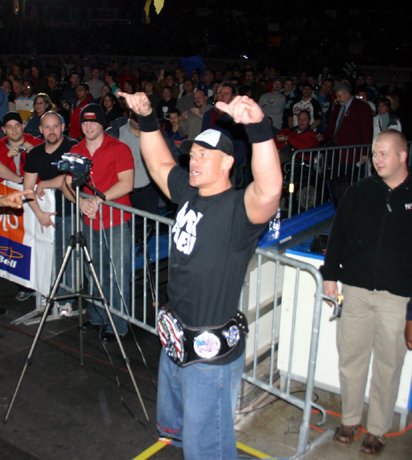
He first won the WWE Championship from JBL at WrestleMania 21 on April 3, 2005. Four days later, Cena walked onto SmackDown as champion and declared, “The champ is here.” A week after that, he introduced the custom spinner WWE Championship that would become one of the defining visuals of his rise.
But Cena did not hold one championship forever. He lost titles, won them back, endured hostile crowds, rebuilt after major defeats and even revived “The Champ” around the United States Championship a decade later.
That is why the phrase lasted.
The belt made “The Champ Is Here” true once. What Cena kept doing afterward gave the words weight.
1. “The Champ Is Here” Only Mattered After Cena Actually Won the Title
Cena already had plenty of confidence before WrestleMania 21.
He had the jerseys.
The chain.
The freestyle insults.
The United States Championship.
The Doctor of Thuganomics persona had helped turn him from another developing WWE wrestler into someone audiences could recognize immediately.
But there is a difference between presenting yourself like the top guy and actually becoming one.
At WrestleMania 21, Cena defeated JBL for his first WWE Championship. He had rebounded from narrowly missing a Royal Rumble victory and earned another path to JBL through a No. 1 contender tournament.
Four days later, the language changed.
Cena did not walk onto SmackDown saying that maybe one day he could become champion.
He could say:
The Champ is here.
There was evidence behind it now.
That distinction matters outside wrestling too.
Confidence can help you enter the room.
But eventually the claim needs proof.
If you want to be treated like the person who can lead the project, solve the problem, win the position or perform at the next level, declaring that identity is only the beginning.
The title does not come from saying you belong there. The work has to catch up with the claim.
That is the first reason “The Champ Is Here” carries more weight than ordinary swagger.
Cena earned the right to say it before the phrase became part of his identity.
Photo: Trevor Botting /
Wikimedia Commons,
CC BY-SA 2.0.
2. The Spinner Belt Made Being Champion Look Like John Cena
Winning the WWE Championship did not suddenly make Cena abandon everything that had made him recognizable.
Instead, he brought that identity to the championship.
On April 14, 2005, Cena introduced a custom WWE Championship built around a spinning center plate and the same flashy hip-hop influence that had shaped his rise.
WWE’s own retrospective places the spinner-belt debut directly after his first title victory and records Cena again announcing that “The Champ is here.”
That visual change matters.
Cena did not simply reach WWE’s established image of a champion.
For better or worse, WWE’s championship started looking like his era.
The spinner belt was loud.
It was unconventional.
Traditional wrestling fans could hate it.
But you could not easily mistake it for somebody else’s presentation.
That is a useful distinction if the championship-era Cena is the version you connect with.
Reaching the next level does not always require sanding away the thing that made you recognizable enough to reach it.
Sometimes the challenge is the opposite.
Can you become more successful without becoming interchangeable?
Cena took pieces of the rapper character—the jewelry, visual excess and hip-hop attitude—and carried them into the main-event version of himself.
That is why a spinner-belt graphic represents something different from a generic Cena championship shirt.
It represents the moment when:
the character he built became the champion he became.

Photo: U.S. Department of Defense /
Wikimedia Commons.
Public domain in the United States.
3. The Phrase Got Stronger Every Time Cena Lost the Right to Say It
“The Champ Is Here” would be a much weaker phrase if Cena had simply won the WWE Championship once and never lost it.
That is not what happened.
Championships changed hands.
Cena lost.
He regained titles.
He had to become a challenger again after being the champion.
WWE’s retrospective on Cena’s world-title history documents that cycle repeatedly rather than presenting one uninterrupted reign.
This changes the meaning of the phrase.
“The Champ Is Here” stops meaning:
I reached the top once.
It becomes:
I know what it takes to get there again.
That version is more useful.
You may get promoted and later find yourself proving your value under a new manager.
Build a successful business and discover that last year’s strategy no longer works.
Reach a fitness target and then lose progress.
Become good at something before entering a room filled with people who are better.
Past success does not exempt you from another test.
Cena’s championships could establish his status, but they could not permanently protect it.
Neither can yours.
Sometimes the hardest part of earning a position is accepting that you may have to earn it again.

Image:
Wikimedia Commons.
4. WrestleMania 29 Changed “The Champ” From Dominance Into Redemption
One of the clearest examples came from Cena’s rivalry with The Rock.
At WrestleMania XXVIII in 2012, Cena lost.
The following year, he returned to face The Rock again—this time with the WWE Championship at stake.
Cena won.
WWE explicitly framed the WrestleMania 29 victory as “long-awaited redemption”, with the win beginning another WWE Championship reign.
That gives “The Champ Is Here” a different meaning from simply walking into every match undefeated.
Cena could stand with the championship again precisely because the previous year had gone wrong.
And that is a more interesting form of status.
The phrase stopped needing to mean “I never lose.”
It could mean:
“Losing did not permanently remove me from the level I know I can reach.”
That is a useful distinction for you too.
One bad launch does not automatically make you bad at business.
One rejection does not determine your professional ceiling.
One failed competition does not prove you cannot compete.
One season below your standard does not erase every capability that got you there.
You still have to do something about the loss.
But the result does not have to become your permanent ranking.
Cena did not erase WrestleMania XXVIII.
He returned to the same opponent a year later and changed what happened next.
That is a much stronger version of “The Champ” than pretending champions never get beaten.

Photo: Krystal Bogner /
Wikimedia Commons,
CC BY 2.0.
5. The U.S. Open Challenge Proved “The Champ” Was Bigger Than the Biggest Belt
By 2015, Cena was no longer using the word “champ” only around WWE’s top championship.
After winning the United States Championship, he began putting the title on the line through the U.S. Open Challenge.
Different opponents could walk onto Raw and accept.
Bad News Barrett did it in London.
Zack Ryder received a hometown opportunity.
Cesaro pushed Cena through matches WWE itself treated as major television contests.
The July 6 match with Cesaro shows why.
WWE described a long, difficult title defense filled with counters and near-falls before Cena retained, ending its recap with the conclusion that “The Champ is still here” and had earned it.
Fans remember the run for a similar reason.
In retrospective discussions, fans repeatedly point to the Open Challenge as a period that made the U.S. Championship feel important, gave opponents opportunities to shine and even changed some long-time skeptics’ views of Cena.
That changes what “champion” means.
The important question becomes less:
Which belt are you holding?
and more:
What are you doing with the position while you hold it?
A title on your résumé can tell people where you reached.
What you do from that position tells them whether the title has substance.
You can hold authority and protect it.
Or you can use it to create opportunities, raise standards and force yourself to keep performing.
Cena’s 2015 run helped make a secondary championship feel consequential precisely because he treated defending it as consequential.
Sometimes the best proof that you deserve a position is what becomes better around you while you occupy it.

Image via
Wikimedia Commons,
CC BY-SA 3.0.
6. “The Champ Is Here” Became Shorthand Because Cena Repeatedly Backed It With a Visual
The wording itself is almost absurdly simple.
Not:
John Cena is WWE Champion.
Not:
The greatest champion has arrived.
Just:
The Champ Is Here.
That simplicity works only if the audience already knows who “The Champ” refers to.
Cena spent years building enough associations around the phrase to make that possible:
- the championship belt,
- the salute,
- the brightly colored merchandise,
- the entrance music,
- the hand gesture,
- and the repeated image of Cena standing in the ring with a title.
That is branding at its most efficient.
The phrase does not need to explain Cena.
It triggers the version of Cena you already know.
This is also why different Cena catchphrases should not be treated as interchangeable.
You Can’t See Me gives you the swagger and visual taunt.
Never Give Up gives you persistence.
Hustle, Loyalty, Respect gives you the code.
The Champ Is Here gives you status that has been tested publicly.
If that is the Cena identity you care about, a championship visual matters more than merely having his face on the shirt.
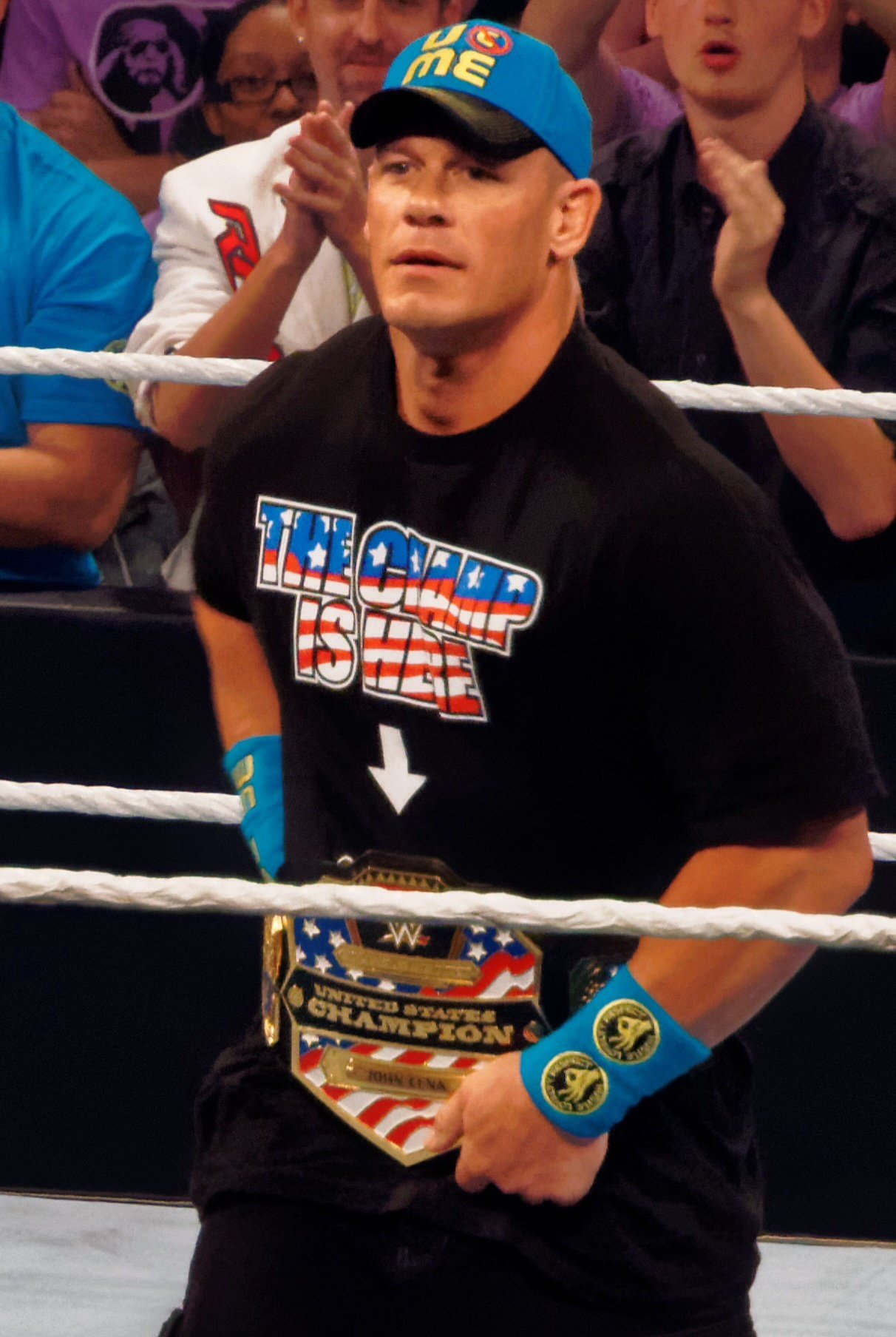
Photo: Miguel Discart /
Wikimedia Commons,
CC BY-SA 2.0.
7. Eventually, “The Champ” Became a Cena Identity Rather Than One Title Reign
Cena’s first WWE Championship gave the phrase its original proof.
But the phrase survived that reign.
It survived later championship losses.
It survived rematches.
It survived the transition from rapper-era Cena to the brightly colored Cenation era.
It survived long enough to be reworked around the United States Championship in 2015.
That longevity is the point.
A championship is temporary by design.
Someone eventually beats the champion.
The belt moves.
A reign ends.
But an identity can survive the specific achievement that originally created it.
That is what happened with Cena.
WWE could still call him “The Champ” during the U.S. Open Challenge because audiences did not need the current WWE Championship around his waist to understand the reference.
There is a lesson in that distinction.
You cannot permanently own a position.
You can build a reputation around what you repeatedly do while occupying it.
The job title may disappear.
The trophy may move to somebody else.
The business may change.
The season ends.
The championship gets defended.
What stays is whether people still associate you with the standard after the symbol of that standard is gone.
That is where “The Champ Is Here” ultimately became bigger than one belt.

Photo: Krystal Bogner /
Wikimedia Commons,
CC BY 2.0.
The Belt Made the Phrase True. The Years Made It Cena’s.
John Cena did not invent confidence.
He did not invent championship celebrations.
And plenty of wrestlers have called themselves champions.
What made The Champ Is Here different was the amount of history that eventually sat behind four ordinary words.
First championship.
Custom spinner belt.
Championship losses.
More title wins.
A defeat to The Rock.
Redemption against The Rock.
Then, years later, a United States Championship run where Cena could still make “The Champ” feel like an identity rather than merely the name of the belt he happened to hold.
That is why the phrase does not have to promise that a champion always wins.
Cena’s own career disproves that.
A better reading is:
Earn the position. Make it your own. Expect to defend it. And if you lose it, decide whether you are willing to earn your way back.
Anyone can say the champ is here.
The interesting part is everything required before other people believe it.
How to Wear John Cena’s “The Champ Is Here” Style
If The Champ Is Here is the Cena you remember—the first WWE Championship, the spinner belt and the moment his rapper identity became a main-event identity—choose a graphic that keeps that championship story visible.
You do not need a shirt simply because Cena’s name is printed on it.
The artwork should point to the chapter you actually want.
CombatWear’s current
John Cena Spinner Belt Senior Rapper Tee
is the clearest fit for that job.
Its main front graphic combines a darker rapper-era Cena portrait with a full-color spinner championship, placing the belt at the visual center of the design.
CombatWear currently lists the standard T-shirt at $16.33, in black, white, military green and sand, with sizes S through 5XL. The current page lists it as a fitted short-sleeve crew neck made from 100% cotton, with fiber content potentially varying by color.
But the important reason to choose it is not the price.
It is the career chapter.
Choose the spinner-belt design when what you want to wear is the point where Cena’s rapper-era presentation and championship status came together.
Choose a Word Life design instead if the character Cena built before reaching the top matters more to you.
Choose Never Give Up if the persistence associated with his later career matters more than the championship itself.
Choose the spinner belt when your Cena is The Champ.
Black gives the colorful championship graphic the strongest contrast.
White makes the belt and portrait read brighter.
Military green or sand can move the graphic toward a more neutral everyday outfit while keeping the spinner championship as the focal point.
Because the current product is listed as fitted rather than oversized, compare your measurements with the CombatWear Size Guide before choosing a size.
You are not wearing a championship graphic because a shirt can make you a champion.
You are wearing the chapter built around the harder part of the phrase:
confidence gets attention; earning the right to keep saying it gives the words weight.