
WWE
7 Reasons Why John Cena’s Never Give Up Message Still Matters

“Never Give Up” is easy to believe when your hero keeps winning.
7 Reasons Why John Cena’s Never Give Up Message Still Matters
It gets more interesting when he loses.
John Cena first wore his orange Never Give Up shirt at Survivor Series 2009, where he successfully defended the WWE Championship against Triple H and Shawn Michaels. WWE later described the shirt as part of Cena’s shift from “lovable thug” toward an inspirational figure, with the slogan becoming closely tied to his public identity.
Sixteen years later, Cena’s final WWE match ended very differently. On December 13, 2025, Gunther trapped him in a sleeper hold and eventually forced him to submit. Cena left his shoes and wristbands in the ring afterward and closed his in-ring career.
For some fans, that finish seemed almost incompatible with the man who had told them never to give up. Reddit discussions after the match captured the tension: some fans felt that seeing Cena tap undermined a message they had carried since childhood, while others interpreted the ending as a more mature lesson about knowing when one chapter is finished.
That disagreement is exactly why the phrase still matters.
Never Give Up is most useful when you stop treating it as a promise that you will always win.
It is a standard for deciding what you do after winning stops being guaranteed.
Here are seven reasons that standard can still be useful long after Cena’s final bell.
1. Never Give Up Gives You a Rule for What Happens After the Result Goes Wrong
Anybody can stay motivated while the scoreboard keeps rewarding them.
The harder question is what you do after the rejection email, failed exam, stalled business, missed promotion, bad workout or result you were convinced would go differently.
Cena’s own explanation of his career makes this distinction useful. In a long-form interview with Chris Van Vliet, he recalled being behind prospects such as Brock Lesnar, Randy Orton, Batista and Shelton Benjamin early in his WWE development. He described setbacks, mistakes and bad performances along the way, but emphasized that the effort and willingness to keep learning remained.
That is a much more practical version of Never Give Up than pretending failure cannot happen.
You can lose the interview and still improve your next application.
You can miss a training target without turning one bad session into three months away from the gym.
You can spend months building something that fails without allowing that result to make every future attempt look pointless.
The outcome already happened. You cannot negotiate with it.
What you still control is whether that outcome gets to make your next decision for you.
That is where Never Give Up starts being useful.

Image: Ed Webster via
Wikimedia Commons.
2. It Moves Your Attention From Winning to What You Can Still Control
There is a dangerous version of motivation that says:
If you work hard enough, you will win.
Real life does not make that promise.
You can prepare well and still lose. Someone else can be better. Timing can be wrong. Circumstances can change. Some outcomes contain luck that effort alone cannot eliminate.
Cena’s career actually makes the stronger argument because he did lose.
He lost championships. He lost major WrestleMania matches. His final match ended in submission.
Yet losing and giving up do not have to mean the same thing.
When Cena discussed the setbacks of his early career, the controllable variables he emphasized were effort, passion and keeping an open mind—not guaranteeing the final result.
That gives you a more durable question to ask when something goes badly:
Did I lose the result, or have I decided to stop doing the work?
Those are different events.
If you are building a business, you cannot command the market to reward you this month. You can decide whether you learn from what customers ignored.
If you are training, you cannot order your body to hit a personal record today. You can control whether you return and train intelligently.
If you are applying for something competitive, you cannot control who else applies. You can control whether rejection becomes information or an identity.
Never Give Up does not give you control over the outcome.
It reminds you not to surrender the controls you still have.

Image via
Wikimedia Commons.
3. It Reminds You Not to Outsource Your Standard to the Crowd
Cena spent years hearing two reactions at the same time:
“Let’s Go Cena.”
“Cena Sucks.”
WWE itself described the divided crowd around his WrestleMania XXVIII match with The Rock and connected his “Rise Above Hate” era to his willingness to continue performing in front of hostile audiences.
That part of the Cena story may be more useful outside wrestling than another championship statistic.
Because sometimes quitting does not start with failure.
It starts with embarrassment.
You publish something nobody notices.
You try a new role and feel inexperienced.
People around you think your idea is stupid.
You start training while surrounded by people much better than you.
You make an attempt publicly and discover that other people have opinions about it.
If your standard depends entirely on applause, persistence becomes almost impossible. You will feel committed when people approve and confused the moment they do not.
The better question is:
Would this still be worth doing if nobody clapped today?
That does not mean criticism should be ignored. Useful criticism should change your thinking.
It means criticism should provide information, not automatically provide your identity.
You do not need everyone in the arena chanting your name before you take the next step.

Image:
WWE.
4. Persistence Usually Means Returning, Not Going Nonstop
“Never Give Up” can sound like you are supposed to maintain maximum intensity forever.
That is not how most real goals work.
Research on everyday persistence describes goal pursuit as often episodic. People stop, resume, get distracted, face competing responsibilities and return later. Persistence therefore involves more than resisting the urge to quit; it also involves recognizing opportunities to act again and actually returning to the goal.
That distinction can save you from one of the easiest ways to abandon something worthwhile:
mistaking interruption for failure.
You missed a week of training.
Return.
Your project went untouched while work became chaotic.
Return.
Your first attempt did not work.
Change it and return.
You lost momentum on something important.
You do not need to recreate the excitement you had on Day One before you start again.
Sometimes Never Give Up does not look dramatic at all.
It looks like opening the document again.
Putting your shoes back on.
Sending the next application.
Making the next call.
Going back after the gap became longer than you wanted to admit.
You do not need an uninterrupted streak to prove that something still matters to you.
You need the ability to return.
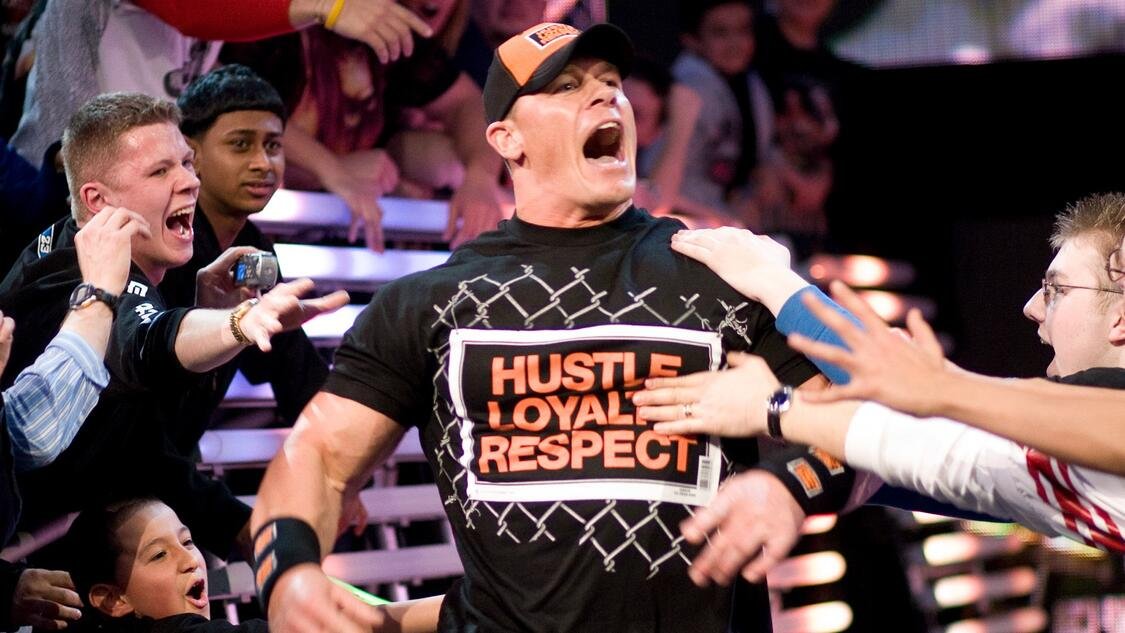
Image:
WWE.
5. A Simple Message Can Be Useful When Motivation Is Not
There is an unusual reason Never Give Up became so closely associated with Cena.
According to Cena himself, he barely used the phrase on WWE television. In a 2011 interview, he said it became strongly associated with him largely because people repeatedly saw it on his T-shirts. He was already receiving messages from fans connecting his slogans with problems in their own lives, including bullying.
That tells you something about how a message travels.
You do not necessarily need another hour-long motivational speech.
Sometimes you need three words at the right moment.
There is psychological research behind the broader usefulness of cues. Experiments on “reminders through association” found that distinctive environmental cues can help people remember intentions when an opportunity to act arrives.
That does not prove that seeing “Never Give Up” on a shirt will make you more disciplined.
A slogan cannot do your work for you.
But a visible message can have a simpler job:
interrupt the automatic decision to quit.
You see it.
You remember the promise you made earlier.
Then you decide what to do.
That is more realistic than expecting motivation to appear every morning before the work begins.

Image:
WWE.
6. The Message Became Bigger Because Cena Kept Showing Up for Other People
Persistence becomes less interesting when it is only about personal achievement.
Cena gave Never Give Up a second meaning through his long relationship with Make-A-Wish.
Guinness World Records verified in July 2022 that Cena had granted 650 wishes through Make-A-Wish, the most recorded for an individual.
Sports Illustrated has also documented how Cena’s younger audience and Make-A-Wish work became intertwined with the values he presented publicly. Children facing serious illnesses increasingly requested to meet him, and Cena continued accepting those wishes on an extraordinary scale.
You do not have to imitate the scale to take something from it.
There will be days when persistence is not about chasing another achievement for yourself.
It is answering when somebody depends on you.
Showing up for your child when work was exhausting.
Keeping a promise to a friend.
Doing the boring part of a team project after the exciting part is over.
Helping someone when there is no audience to reward you for it.
Sometimes Never Give Up means continuing toward a goal.
Sometimes it means remaining the person other people can count on while pursuing it.
That is a harder standard than motivational language alone.
And probably a more useful one.
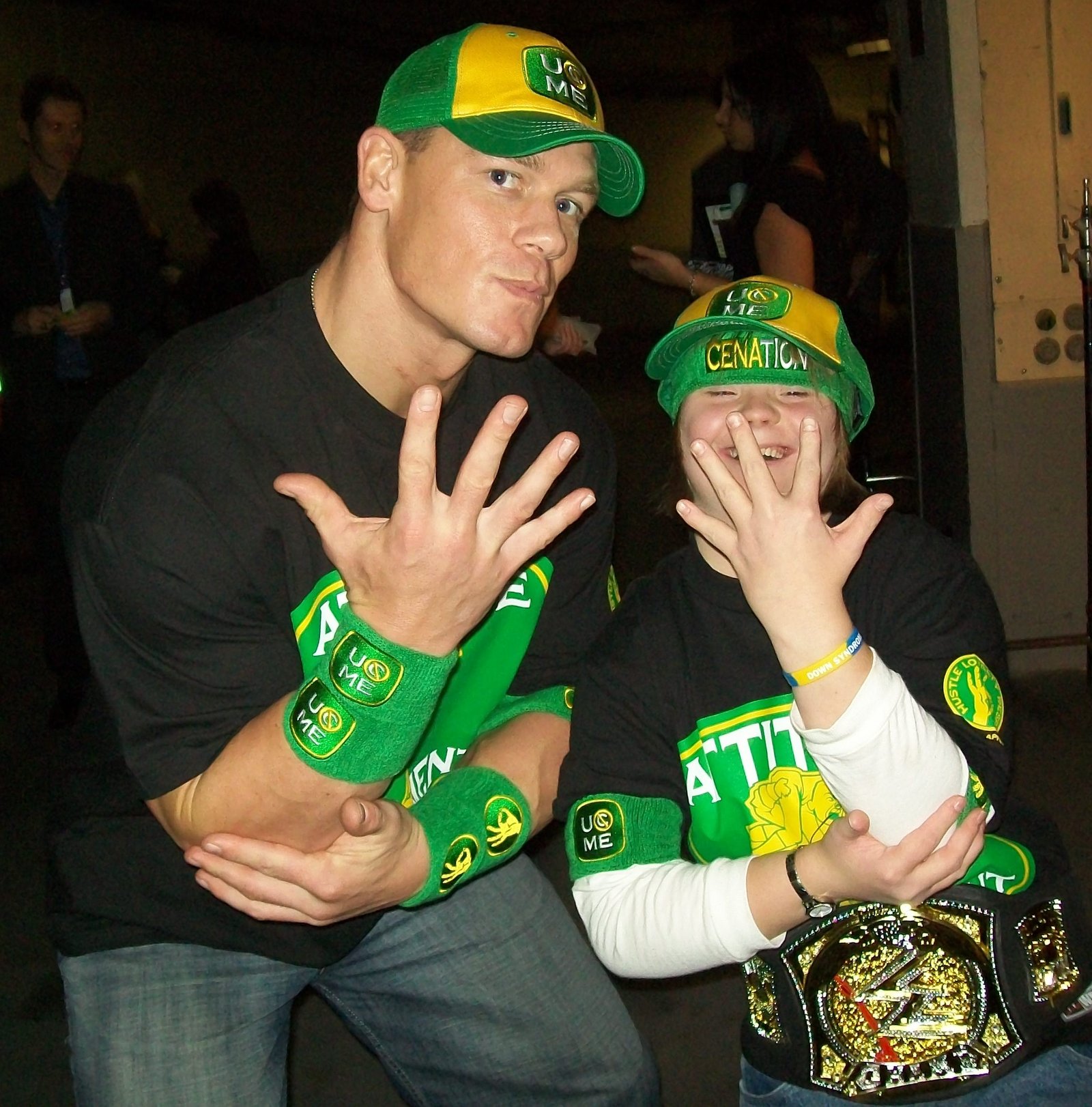
Image via
Wikimedia Commons.
7. The Message Gets Better When You Stop Taking “Never” Literally
This is the part an adult interpretation of Never Give Up needs.
There are things you should give up.
A strategy that repeatedly fails.
A business model nobody wants.
A dangerous training method.
A relationship that should end.
A target that circumstances have made impossible.
A version of your future that no longer matches who you are.
Psychological research on self-regulation does not argue for persistence at any cost. Reviews of goal pursuit describe both persistence and timely disengagement as important parts of successful self-regulation. When a goal becomes genuinely unattainable or no longer valuable, disengaging and redirecting effort can be adaptive.
A large 2025 meta-analysis covering 235 studies likewise treated disengagement, reengagement and flexible goal adjustment as distinct responses people use when goals become difficult.
That makes the argument around Cena’s final match especially interesting.
On December 13, 2025, the man identified for years with Never Give Up finally tapped out. Some fans hated the symbolism. Others saw his smile and submission as recognition that the fight—and his in-ring career—had reached its end.
You do not need to agree with that booking decision to take the useful distinction from it:
Giving up one battle is not always the same as giving up what you stand for.
You can abandon the method without abandoning the mission.
Change the deadline without abandoning the goal.
Leave one career and keep the ambition.
Stop one project and take what you learned into the next.
Admit that something is over without deciding that you are finished.
The mature version of Never Give Up is therefore not:
Keep doing the same thing forever.
It is closer to:
Do not let one failed approach, one loss or one closed chapter make you abandon what is still worth fighting for.

Image:
WWE.
Never Give Up Does Not Mean Never Lose
John Cena’s message lasted because the words eventually became bigger than wrestling results.
Cena won.
Cena lost.
Crowds cheered him.
Crowds booed him.
He became champion again and again.
Then eventually he walked away from the ring.
None of those things make the useful part of Never Give Up disappear.
Because you probably do not need a promise that everything will work out.
You need something more practical:
One bad result does not get to decide the whole story.
Keep the goal when the goal is still worth it.
Change the plan when the plan is not working.
Rest when you need to.
Return when you can.
Listen to criticism without handing it control of your identity.
And when one chapter really is finished, take whatever it taught you into the next one.
That is a version of Never Give Up you can actually live with.
How to Wear John Cena’s Never Give Up Style
If the Never Give Up message is the part of John Cena you connect with most, you do not need to recreate an exact WWE entrance outfit to carry that identity into what you wear.
Start with the message itself.
Cena helped make Never Give Up recognizable through the shirts he wore, turning three simple words into one of the clearest visual signatures of his WWE career. That makes a Never Give Up-inspired tee a more natural choice if you care about the attitude behind Cena than a shirt tied to one match, championship or era.
The current CombatWear John Cena Legacy Shirt is one way to bring that broader Cena identity into an everyday outfit.
Choose it when you want your John Cena style to say more than “I watched this wrestler.”
Choose it when the part you want to keep visible is the standard behind the character:
A bad result does not get to decide what you do next.
Pairing that kind of Cena graphic with simple jeans, cargos or everyday sneakers also lets the message remain the focus instead of turning the whole outfit into wrestling cosplay.
You are not wearing the shirt to borrow Cena’s persistence.
You are wearing it because Never Give Up already means something to you — and you want your style to make that visible.